
Is “The Gapper” dead?
Major League Baseball ponders changes meant to save the extra-base hit

Someone please do a wellness check on Bob Costas. His skull may be exploding.
Baseball, a game convicted of being chained to a black and white still-photo past is still basking in the success of recent changes—a pitch clock, larger bases and a ban on the infield shift among them. Rather than resting on their laurels, it would seem a few guardians of the MLB product would like to unlimber a fresh batch of alterations, this time in the outfield in a quest to revive “the gapper.” You may not have noticed, but we aren’t seeing as many doubles and triples these days, admittedly some of the game’s most exciting plays.
The Athletic’s Jayson Stark—in a story where I and presumably many other fans are first finding out that this is even an issue—cites Baseball Reference numbers that show the rate of doubles per game (1.59) fell this year to its lowest level in more than three decades while the rate of triples per game (0.13) plunged to a level that tied the lowest in history. “We’ve made nearly 1,500 doubles disappear since 2007,” he writes, “and we’ve made over 300 triples disappear since 2015.”
And how’d that happen? What else. Analytics.
Stark says baseball’s new information age brought us the “no-doubles defense” which ordains that an outfielder’s butt cheeks need to be scraping the wall in an effort to curtail the extra base hit—not just near the game’s end but thought the contest—because the numbers prove it’s easier for a runner to score from second or third than it is from first. Stark refers to FanGraphs’ Run Expectancy Matrix, which guys like him apparently keep a copy of on their coffee tables at home. He says that “when a team puts a runner on second with nobody out, its run expectancy for that inning is 29 percent higher than when that runner is on first with no outs. And with two outs, run expectancy is 48 percent higher.”
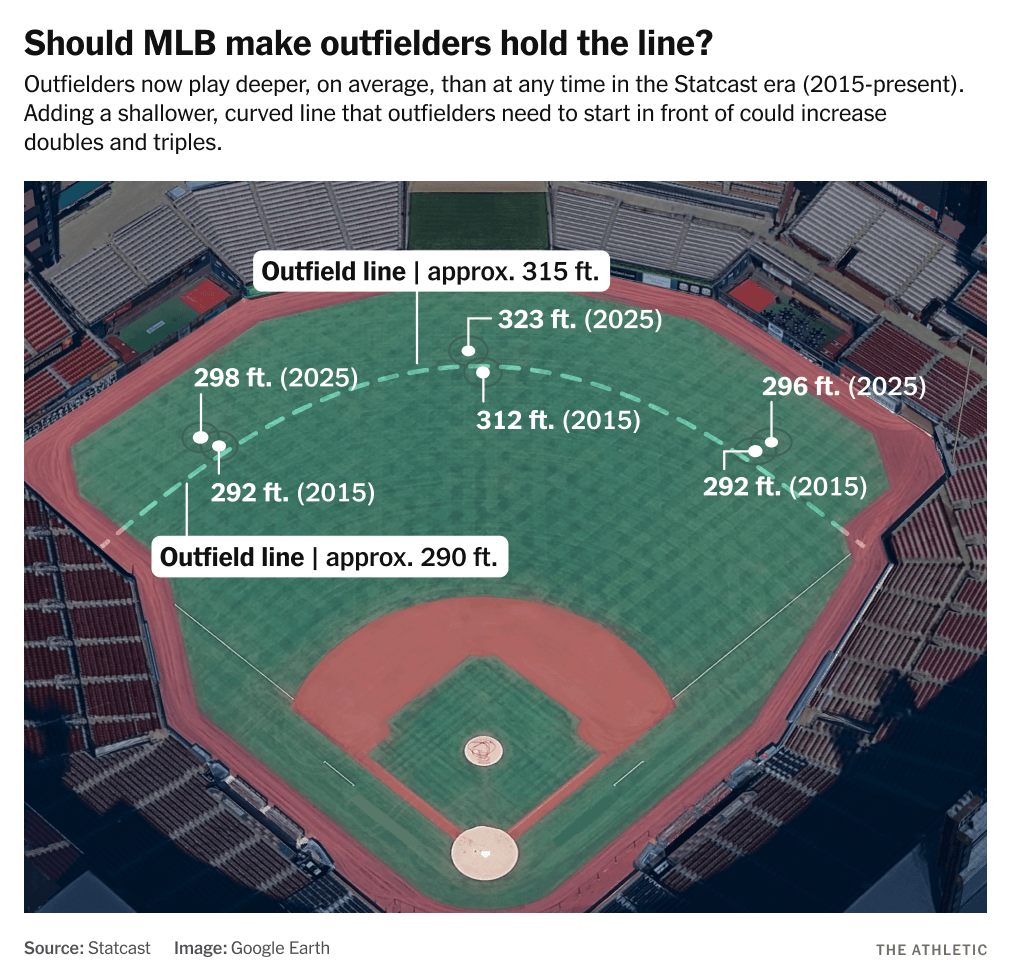
You might have also noticed over the years that MLB outfielders developed a new tick: they doff their caps seemingly before each new opposition at-bat to consult a card hidden inside, telling him where to be. Again, we can thank the spread of intel and the proliferation of game video for giving number crunchers and tendancy-watchers what they need to reveal a hitter’s tendencies. The new interest in outfield positioning and its impact is creating a fear among baseball marketers that fans are being cheated out of the action that makes them buy tickets—the same motivation that led to the banning of the infield shift a few seasons back. Among the potential solutions is a line—cut into the grass or marked by chalk—telling outfielders how deep they can play as an at-bat starts. There’s also talk of even more extreme measures that would tell them where they have to stand before the ball is in play.
Let the debate begin.
These proposed changes are only in the discussion phase, so there’s plenty of time to haggle. There’s no debate about the action-value that the extra base hit brings to the proceedings—increasing the number of balls-in-play is always a noble quest—but is there enough evidence to show we have a problem the players themselves can’t fix? Is this an answer in search of a problem? Or, are MLB rules warriors being unusually ahead of the curve, proactively considering a change before it becomes an even larger issue? What then of fans who needed a while to accept the most recent batch of tweaks a few seasons ago. How much change are they able to process in such a short amount of time?
The game certainly has bigger fish to fry. The current collective bargaining agreement expires at the end of the 2026 season and conventional wisdom says the ‘27 campaign is in danger of not starting as scheduled, if at all. The fate of the gapper is probably going to to remain in limbo as MLB owners and players haggle over weighty matters like salary caps/floors and competitive balance as they are a more existential baseball concern. The immediate issue for many a fan is what is going down as the Hot Stove fires up, and how their favorite teams will fluff their rosters in hopes success come spring.
Hope that wellness check on Mr. Costas proves that his head is, indeed, intact. The game needs his big ol’ melon along with those of others with his wisdom/respect for the game to talk us through the labor slog that seems inevitable.
The “gapper” can apparently wait.